

How To Check Battery Percentage On Kodak Camera
The Imaging Resource
Quick Review
Kodak EasyShare DX4330 Digital Camera
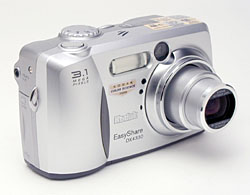 | Photographic camera QuickLook | |
| Review Date | | |
| User Level | | |
| Product Uses | | |
| Digicam Design | | |
| Picture Quality | Good, three.i-megapixel CCD | |
| Print Sizes | Good prints to 8x10 | |
| Availability | Now | |
| Suggested Retail Toll | | |
Introduction
Eastman Kodak Company has a long history of bringing professional person imaging processes to the everyday consumer. Kodak's EasyShare System is the company'due south digital equivalent to its turn-of-the-century Brownie box camera, which came with preloaded film and no manual controls (once users shot all their film, they simply sent the boxes back to Kodak for processing and printing). While the get-go ii Kodak EasyShare digicams, the DX3500 and DX3600, were much more than sophisticated than a Credibility, they did feature the aforementioned "merely press the button" simplicity, with fully automatic controls and an optional docking station that takes all of the guesswork out of digital image manipulation, management, and sharing. Equally Kodak has evolved the line, they've introduced more advanced cameras that do offering a few user options, but which still retain first-class ease-of-use. The subject of the current review is the EasyShare DX4330, a compact three megapixel blueprint that provides good midrange functionality, combined with a very clear menu organization and the latest version of Kodak's Picture Software.
Kodak's Picture Software is a big part of the Easy Share story, and so much so that I keep hoping to find time to devote a full article to information technology on its own. Especially in its latest implementation, it walks you through every step of uploading, enhancing, and emailing your photos -- and has virtually the most graphically intuitive interface of whatever consumer imaging software I've seen. It automatically sizes the images for printing or emailing, stores copies, applies simple furnishings, and allows y'all to make image corrections, such as color, brightness, and contrast adjustments. The entire line of EasyShare cameras are amid the easiest and most goof-proof digicams out there, and the DX4330 and Kodak's latest Picture Software carry on that tradition admirably.
Camera Overview
The latest addition to Kodak's exceptionally user-friendly line of digicams, the EasyShare DX4330 projects a similar aesthetic to the residual of the EasyShare line. Meaty, curvy, and similar in style to a traditional signal-and-shoot 35mm film camera, the DX4330 measures only 4.three ten 1.v 10 2.6 inches (110.v x 39.0 ten 66.0 millimeters). The camera's all-plastic body makes it light weight as well, at vii.4 ounces (210 grams) with the battery and memory card, making it a comfy fit for well-nigh hands. The DX4330 squeezes into larger shirt and glaze pockets, and comes with a wrist strap for carrying. The photographic camera'southward compact design includes a retractable lens, protected by a removable plastic lens cap (a tiny strap tethers information technology to the camera body). The three.1-megapixel CCD captures high resolution, impress quality images, every bit well as smaller epitome sizes improve suited for distributing via email.
The DX4330 features a 3x zoom lens, equivalent to a 38-114mm zoom on a 35mm lens. (That's a moderate wide angle to a medium telephoto, a fairly typical range amongst indicate & shoot digicams.) The photographic camera's autofocus mechanism uses a multi-zone system to "notice" the master field of study closest to the lens. The AF area is highlighted in the LCD display with a set of brackets. The DX4330 has a maximum aperture ranging from f/2.8 to f/5.1, depending on the zoom position. Focus ranges from two feet (0.six meters) to infinity. In Macro way, focus ranges from 2.viii to 28 inches (7 to lxx centimeters). A Landscape shooting mode fixes focus at infinity, for distant subjects and scenery. In addition to the 3x optical zoom, the DX4330 besides offers 3.3x Avant-garde digital zoom, which effectively increases the photographic camera'due south zoom range to a total of 10x. Keep in mind though, that digital zoom decreases the overall image quality, since it merely "stretches" the eye pixels of the CCD epitome. For composing images, the DX4330 offers both a real-image optical viewfinder every bit well as a 1.8-inch color LCD monitor. Equally is usually the case, I found the LCD monitor much more accurate for framing. (Interestingly though, both viewfinders resulted in a smaller paradigm surface area when framing at full telephoto.)
Exposure control is fully automated on the DX4330, though the camera does offer a Long Shutter mode that allows longer exposures up to four seconds. A Fashion dial on top of the camera offers options of Automobile, Sports, Night, Landscape, Macro, and Movie modes. While Auto mode is best for general photography, the remaining preset modes help with special shooting situations such as night shots in the city or the winning goal of a soccer game. In Sports mode, the camera uses faster shutter speeds to "freeze" action. Night mode optimizes the camera for darker portraits and other night scenes, automatically combining the flash with a slower shutter speed to let more light into the image from the surroundings. This brightens the groundwork in wink shots, making for more natural-looking nighttime photos. (You tin cancel the flash in Night mode likewise, for those times when you want to shoot with just the available light.) Landscape mode fixes focus at infinity, for capturing subjects more about 58 anxiety (17.five meters) away from the camera.
The DX4330 employs a matrix metering system, which bases the exposure on several lite readings taken throughout the frame. Although you can't adjust the discontinuity, shutter speed, or metering manner (autonomously from the Long Shutter mode that I'll get to in a scrap), y'all tin can increase or decrease the overall exposure through the Exposure Compensation setting under the Record carte. Exposure compensation adjusts the exposure from -ii to +2 exposure equivalents (EV) in one-half-footstep increments. (Each full EV unit of measurement of adjustment represents a factor of two increase or subtract in the exposure.) White balance remains under automated control at all times, but the DX4330 does a really first-class job under well-nigh low-cal sources. Using Kodak's proprietary Color Scientific discipline technology, the DX4330 manages to achieve an accurate color remainder under an amazingly wide range of lighting conditions. ISO remains nether automatic control as well, varying from 120 to 200 equivalent settings. The congenital-in flash is constructive from 2.0 to 11.two feet (0.6 to 3.iv meters) depending on the setting of the zoom lens, and features Auto, Fill, Red-Center Reduction, and Off operating modes. For shooting in low calorie-free conditions without the wink, a special Long Shutter manner lets you manually select exposure times from 0.7 to 4.0 seconds. Using Long Shutter fashion, you can capture brilliant, usable images at light levels merely half as bright every bit typical metropolis streetlighting. You'll need to use the infinity focus mode for shooting under very dim lighting though, because the 4330's autofocus arrangement doesn't work finer at light levels darker two to four times brighter than typical urban center street lighting. A 10-second Self-Timer mode provides a filibuster between the time the Shutter button is pressed and when the shutter actually opens, and so you lot tin go into your own shots.
In addition to its still photography modes, the DX4330 also offers a Film recording style for capturing moving images with sound. Recording stops and starts with a cursory, full press of the Shutter button, but if you hold the button down for more than a second or two, the camera will automatically end recording when you let it dorsum upward again. Every bit you record, the duration of the movie appears in a running counter on the LCD monitor. Maximum movie lengths depend on the amount of memory space available. (The 16 megabytes of internal retention will let you record movies up to 64 seconds in length.)
The DX4330 is compatible with Kodak's EasyShare camera dock, which offers hassle-complimentary epitome downloading. You but put the photographic camera into the dock (a plastic dock insert fits the DX4330 bottom to the dock and comes with the photographic camera) and press the Connect push button on the dock. The dock station also serves every bit an Ac adapter and in-camera bombardment charger (with Kodak NiMH battery packs). Built into the DX4330 is 16 megabytes of internal retentivity, but the camera likewise features an SD memory card slot and so you tin can expand the camera's retention capacity. I highly recommend picking up at to the lowest degree a 32 or 64 megabyte menu correct away, given the photographic camera's 2,160 10 1,440-pixel maximum resolution size. For power, the DX4330 uses either two AA-type lithium or NiMH batteries, or a single CRV3 lithium battery pack. As always, I strongly recommend purchasing a couple of sets of high-capacity NiMH batteries and a good charger, and keeping a spare set of batteries charged at all times. Click here to read my "battery shootout" page to see which batteries currently on the market are all-time, or here for my review of the Maha C-204F charger, my longtime favorite. The Kodak EasyShare dock is itself a battery charger, and comes with a unmarried NiMH battery pack, simply I highly recommend purchasing some other set of high-chapters NiMH AA cells, so y'all'll have spares to pack along on long outings.
Basic Features
- 3.i-megapixel CCD delivering images as large as 2,160 x 1,440 pixels.
- Real-image optical viewfinder.
- ane.8-inch color LCD monitor.
- 3x, 38-114mm (35mm equivalent) lens.
- 3.3x Avant-garde digital zoom.
- Automated exposure command.
- Automated white remainder control.
- Maximum aperture of f/2.8 to f/5.one, depending on lens zoom position.
- Built-in flash with 4 modes.
- 16MB internal memory.
- SD/MMC carte storage (optional, card not included).
- Power supplied by two AA-type batteries, i CRV3 lithium battery, Kodak NiMH pack, or optional Air-conditioning adapter.
- Compatible with optional Kodak EasyShare camera dock (non included).
- Kodak Picture Software included for both Windows and Mac platforms.
Special Features
- Movie mode (with sound).
- Nighttime, Sport, and Mural photography modes.
- ten-2d Self-Timer for delayed shutter release.
- Long Shutter mode for longer exposures (maximum four seconds).
- Macro (shut-up) lens setting.
- DPOF (Digital Print Lodge Format) compatibility.
- USB cablevision for connection to a figurer (driver software included).
Recommendation
The DX4330 is an ideal pick for anyone looking for a no-fuss digicam with great image quality. Just almost everything is automatically controlled, with nifty results. That said, the DX4330 does offering a few options for extending its functioning. The camera continues with Kodak's very convenient interface, making it a adept pick for kids or novice users. Like Kodak's other EasyShare cameras, when combined with the accessory camera dock, the DX4330 is i of the easiest to employ cameras I've seen.
Design
Compact and reasonably pocket-sized in size, the DX4330 measures 4.iii x 1.5 x 2.half-dozen inches (110.5 x 39.0 10 66.0 millimeters), just pocket-sized enough to fit into coat pockets and purses, and possibly larger shirt pockets. The DX4330 is low-cal weight as well, at just 7.iv ounces (210 grams) with batteries and memory card. A wrist strap comes with the camera, but I'd recommend a soft carrying example for travel.
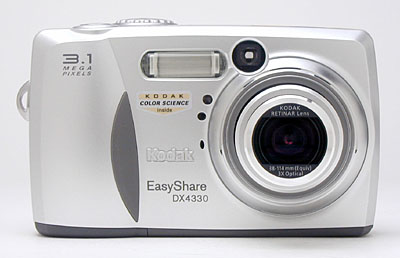
The telescoping lens takes up the right side of the camera'due south front panel, surrounded by a thick, plastic lip complete with filter threads for accessory lenses. The lens extends outward approximately another 7/8 inch when the camera is powered on. Also on the front panel are the optical viewfinder window, wink, self-timer lamp, light sensor, and tiny microphone. A gently-sculpted hand grip on the side of the photographic camera features a soft, rubbery pad for fingers to cling to.
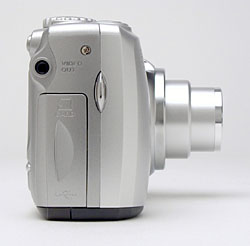
On the right side of the photographic camera (equally viewed from the rear) is the SD memory card compartment and Video Out jack. A hinged plastic door protects the compartment, and opens from the back panel. Below the SD carte slot is the USB jack, for connecting the camera directly to a figurer. A shiny silver eyelet is too on this side of the camera, for attaching the wrist strap.
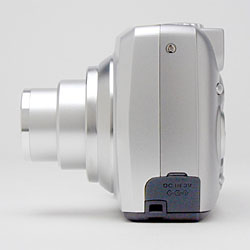
The opposite side of the camera features the DC In jack, covered by a flexible flap. A pocket-sized eyelet but below the jack compartment provides an attachment indicate for the lens cap strap.
The Shutter button, Mode dial, Flash button, and speaker are all on the DX4330's top panel, which is slightly curved.
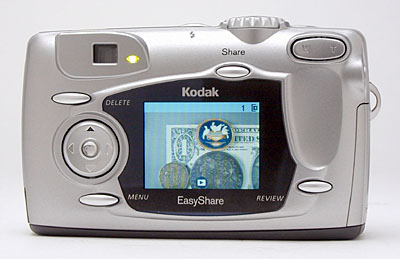
The rest of the camera controls are on the dorsum panel, along with the optical viewfinder and LCD monitor. An indented thumb residue on the right side cups your thumb every bit you hold the camera, reinforcing the front handgrip. Above the thumb rest is the zoom rocker button. The Share, Delete, Card, and Review buttons are at each corner of the LCD monitor, and beetle slightly from the back panel. I liked the operation of the Four-Fashion Arrow pad on the left side of the LCD monitor, which has a rubbery point in the eye that makes it easy to grip. The optical viewfinder eyepiece is quite small, simply has a fairly high eyepoint to accommodate eyeglass wearers (I could run into the full frame even with my heart a good distance from the camera). Next to the viewfinder is a minor LED lamp, which lights or flashes to indicate camera status (such equally when focus is set up, flash is charging, etc.).
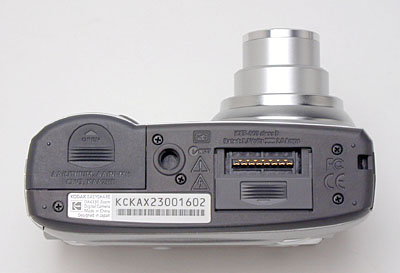
On the bottom panel of the DX4330 are the tripod mountain, dock jack, and bombardment compartment. The plastic, threaded tripod mountain is off-center and besides close to the bombardment compartment for quick battery changes while working with a tripod. (I doubt that this will be of much concern to most users though, as the DX4330 is conspicuously designed for on-the-get shooting.) I prefer metal tripod sockets, but the small size and depression weight of the DX4330 mean the plastic socket should hold up fine. The battery compartment features a locking, hinged door, which slides forward to open. The dock connection jack is protected by a sliding plastic door, and connects the camera directly to the EasyShare dock for quick image downloading.
Camera Operation
Equally I've come to await from Kodak's EasyShare digicam line, the DX4330 has a very user-friendly interface. The fully automatic exposure command and express exposure options continue user decisions to a minimum, while the camera's automated systems practice an excellent task of capturing expert-looking photos. The LCD menu organisation is short and uncomplicated to navigate the plain-English descriptions of menu items are a welcome change from the too-common ambiguous icons on then many other cameras. A Manner dial lets you change camera modes quickly, and once more manifestly-English descriptions flashed on the LCD screen brand operation straightforward for even rank beginners. Given the uncomplicated interface and limited controls, yous should exist able to snap images right abroad, with hardly a glance at the transmission.
External Controls

Shutter Button: Located on the photographic camera's top panel, this push sets focus and exposure when halfway pressed, and fires the shutter when fully pressed. In Playback fashion, pressing this push returns the camera to the selected Record style.
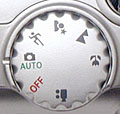
Way Dial: Just behind the Shutter button, this dial controls the camera'southward main operating mode, with the post-obit options available:

Flash Push button: To the left of the Fashion dial, this button cycles through the Auto, Fill, Ruby-red-Heart Reduction, and Off flash modes.
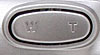
Zoom Toggle Push button: In the top correct corner of the rear console, this button controls the optical and digital zoom in whatsoever record fashion. In Playback mode, this button lets y'all zoom in on captured images, to cheque focus or framing.

Share Push button: Above the tiptop right corner of the LCD monitor, this push button lets y'all tag images for printing, emailing, or as a favorite image. (A centre icon appears on "favorite" images.) Pressing this button in Review style displays the Share menu, with options for DPOF, Email, or Favorite.

Delete: Just above the Four-Way Arrow pad, this push button calls upwardly the Delete carte in Review mode. You tin delete individual images or all images on the card. There'south also an option to abolish.
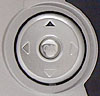
Four-Manner Arrow Pad: Dominating the left side of the camera's back panel, this rocker button features 4 arrows. In whatsoever settings card, the arrow keys navigate through options. Pressing the rubbery center of the button acts as the "OK" to confirm selections. In Tape manner, the eye push likewise controls the LCD display, turning information technology on or off. In Playback mode, the correct and left arrows scroll through captured images and movies, while the center button acts equally a shortcut to the 2x and 4x image enlargement screens.

Menu Button: Immediately below the Iv-Mode Arrow pad, this push displays the settings menu in Playback or Record modes.
Review Button: The final control on the back panel, this button is located in the lower right corner. Pressing this button in any Record mode activates Playback manner. Once in Playback mode, pressing the Shutter push returns to the Record display.
Camera Modes and Menus
 Film Mode: The first mode on the Way dial, Movie mode is indicated by a movie photographic camera icon. In this mode, y'all can record 309 x 206-pixel resolution movies with audio, at xv frames per second.
 Auto Mode: Marked with a camera icon and the word "Machine," this mode is best for well-nigh average shooting conditions. Exposure is automatically controlled, but a modest option of user options is available through the Record menu.
 Sports Mode: A small black icon of a person in motion marks this mode on the Mode dial, which uses faster shutter speeds to capture fast-moving subjects.
 Dark Mode: This manner is indicated by a person with a star on the Mode punch, and uses longer exposure times to capture vivid images in low low-cal.
 Landscape Way: A mountain icon indicates this mode on the Mode punch. Here, the camera fixes focus at infinity for distant subjects and scenery.
 Macro Mode: The traditional flower macro symbol marks this mode on the Style dial. The focus range changes for close-upward subjects in this mode, and limited exposure options are available.
Playback Mode: Accessed by pressing the Review button, this mode lets y'all review captured images and movies, every bit well as manage files.
 Record Carte du jour: The following carte du jour items appear whenever the Menu button is pressed in whatsoever Record style. However, not all menu options are bachelor in all modes.
- Self-Timer: Turns the ten-second self-timer on or off.
- Image Storage: Dictates where images are stored, either in the 16MB internal memory or SD bill of fare.
- Exposure Compensation: Adjusts the overall exposure from -2 to +two exposure equivalents (EV) in one-half-step increments.
- Long Time Exposure: Accesses longer exposure times, for darker shooting conditions. Manually-selected shutter speeds range from 0.7 to four.0 seconds.
- Picture Quality: Sets the image resolution to Best (2160 x 1440 pixels), Better (1800 ten 1200 pixels), or Good (1080 x 720 pixels).
- Engagement Stamp: Turns the appointment stamp function on or off, which records the date over the image. Yous tin can cull from a option of date formats as well.
- Orientation Sensor: Controls the camera'southward orientation sensor, which detects when the camera is held vertically. Vertical-format images captured when the Orientation Sensor is enabled are rotated to their right orientation on-screen when they're played back.)
-
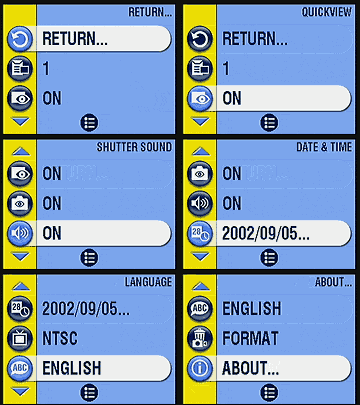 Setup Menu: Accesses the following main camera settings:
 - Return: Returns to the previous menu display.
- Default Print Quantity: Sets the default number of prints specified when "tagging" images.
- Quickview: Turns Quickview on or off. Quickview automatically displays the well-nigh recently captured image, with options to delete or Share.
- Liveview: Disables the LCD's "live" view, meaning yous tin turn off the LCD as a viewfinder by pressing the center of the Four Style Arrow pad. If off, the LCD remains active at all times.
- Shutter Sound: Enables the shutter racket or turns information technology off.
- Date & Time: Sets the camera's internal clock and calendar.
- Video Out: Specifies PAL or NTSC as the Video Out signal.
- Language: Sets the card language to English language, German, Spanish, French, Italian, Portuguese, or Japanese.
- Format: Formats the SD memory bill of fare or internal memory.
- About: Displays the camera's firmware data.
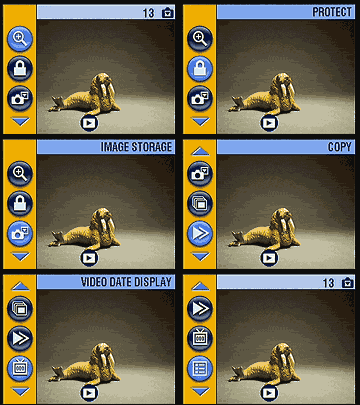
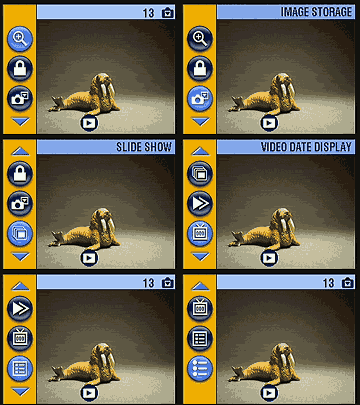 Playback Menu:
- Magnify: Enlarges the displayed epitome, so that y'all tin can check on fine item and framing.
- Protect: Write-protects the displayed prototype, preventing information technology from beingness accidentally erased or manipulated (except via memory or carte du jour formatting). Also removes protection.
- Paradigm Storage: Selects between the internal memory or the SD card for image storage.
- Slide Show: Enables a slide show of captured images, with user-adaptable intervals between images.
- Copy: Copies files from the internal memory to the SD carte du jour, or the opposite.
- Video Date Display: Turns on the date display over moving picture files, with a choice of formats.
- Picture Info: Displays the filename, directory, date, time, and quality data for the current image.
- Setup Card: Displays the same settings as under the Tape menu.
Test Images
See our exam images and detailed analysis here. The thumbnails beneath bear witness a subset of our test images. Click on a thumbnail to encounter the full-size photograph.
- Color: Although the DX4330 offers only automatically-controlled white balance, it does a superb job of interpreting near light sources. In my testing, the DX4330 handled most lighting well, fifty-fifty the very hard incandescent lighting of my Indoor Portrait (without flash) test. Squinting a little, I could say that I noticed slightly warm tints on the Outdoor Portrait, Davebox, and Musicians target, merely the color was notwithstanding excellent all around. Saturation was skilful throughout, as well, with colors actualization bright and vibrant. The DX4330 handled the oft-difficult blue flowers in the Outdoor Portrait very well, with only the faintest royal tints. Additionally, the photographic camera captured the tough tonal variations on the Davebox target, and reproduced the large color blocks well. Overall, the DX4330 produced fantabulous colour in all my tests.
- Exposure: While exposure was generally accurate, contrast was a footling in some cases, notably in the outdoor house, Macro, and Outdoor Portrait shots. The 4330's images were bright and "snappy," but that came at the cost of highlight detail whenever the lighting was harsh and contrasty. Although the DX4330 tended to lose highlight detail, it kept midtones where they should be, and did a adept chore of preserving shadow detail.
- Resolution/Sharpness: On the whole, the DX4330'south in-camera sharpening did a skillful job, and divers details well. The lens produced some softness in the corners of the images, most noticeable in close-up shots. Overall sharpness and detail were quite good though, a solid 3-megapixel operation.
- Closeups: The DX4330 captured an average to slightly ameliorate-than-average sized macro area, at 3.07 x 2.05 inches (78.0 x 52.0 millimeters). Resolution was loftier, with strong item in the dollar pecker, coins and brooch. Corner softness was much stronger on this shot than whatsoever other (a typical trouble for consumer-course digicams in closeup shooting), and extended far into the frame. The camera's built-in wink is positioned as well loftier and to the right on the camera body to illuminate the macro area well, and thus resulted in potent shadow in the bottom left corner of the frame. (Plan on using external lighting for your closest macro shots.)
- Dark Shots: The DX4330's "Long Time Exposure" fashion offers a maximum shutter time of iv seconds, long enough to capture brilliant images at the 1/ii foot-candle (5.5 lux) light level. For reference, this is about half as bright as typical metropolis street lighting at night, so the camera should do well for dark shots under artificial illumination. The target was reasonably bright at the 1/4 foot-candle (ii.7 lux) setting, every bit well. Noise was moderately low, and color was about right, though warm. The biggest trouble here was the camera's autofocus organisation, which had problem fifty-fifty at the one foot-candle (11 lux) low-cal level. - You'll take to apply the infinity-focused "Landscape" way for any shots nether dim lighting, precluding any nighttime closeups.
- Viewfinder Accuracy: The DX4330's optical viewfinder ranges from a little tight at wide angle zoom settings (85.six pct of the terminal frame shown) to almost exact at telephoto settings (99% of the final frame shown). While I like to see viewfinders every bit accurate as possible, I'd like fifty-fifty more for them to behave consistently across the zoom range. - As it is, with the 4330, you'll need to learn to frame a scrap tighter for wide bending shots than you volition for telephoto. Too, the view varies from existence shifted down a little at wide angle, to being shifted upward slightly at telephoto. The LCD monitor fared much better, at wide bending anyway, where I measured approximately 99 percent accuracy, well-nigh perfect.
- Optical Distortion: Optical distortion on the DX4330 is better than boilerplate at the broad-angle end, every bit I measured a 0.47 percentage barrel distortion. The telephoto end better even so, as I simply measured an about-imperceptible two pixels of barrel distortion. Chromatic aberration is moderate, showing about iv or five pixels of coloration on either side of the target lines. (This distortion is visible as a very slight colored fringe effectually the objects at the edges of the field of view on the resolution target.) The DX4330 also showed some corner softness, by far the most axiomatic in the Macro shot. While I'd similar to see less chromatic aberration and sharper corners in macro mode, I really liked the depression barrel distortion of 4330's lens.
- Bombardment Life: The DX4330 operates from a pair of AA-blazon batteries, preferably high-capacity NiMH rechargeables. Battery life is surprisingly good for a camera running on only a pair of AAs. Based on my power drain measurements, worst-example battery life (capture way with the LCD turned on) should be about an hour and a half with expert-quality NiMH cells. With the LCD off, capture-style run time increases to an astonishing 11 hours, and run time in playback mode is more than ii and a half hours. I nevertheless strongly recommend purchasing at least two sets of batteries and a good charger though. Click here to read my "battery shootout" page to come across which batteries currently on the market are all-time, or here for my review of the Maha C-204F charger, my longtime favorite. The Kodak EasyShare dock is itself a bombardment charger, and comes with a single NiMH battery pack, but I highly recommend purchasing another set of high-capacity NiMH AA cells, and so you'll have spares to pack along on long outings.
In the Box
In the box are the following items:
- Kodak EasyShare DX4330 digital photographic camera.
- CRV3 lithium battery pack.
- USB cable.
- A/V cable.
- Wrist strap.
- Lens cap with strap.
- EasyShare dock insert.
- Software CD-ROM.
- Operating manual and registration card.
Recommended Accessories
- Large chapters SD memory card. (I'd recommend 32MB as a bare minimum, 64MB would be preferable.)
- Additional set of rechargeable batteries or bombardment pack.
- Air conditioning adapter.
- Small camera instance.
- EasyShare camera dock.
Recommended Software: Rescue your images!
Just as of import as an extra retentivity carte du jour is a tool to rescue your images when 1 of your cards fails at some point in the future. I get a lot of email from readers who've lost photos due to a corrupted retentiveness carte. Memory menu corruption can happen with any bill of fare blazon and any camera manufacturer, nobody's immune. A surprising number of "lost" images can be recovered with an inexpensive, piece of cake to utilise piece of software though. Given the corporeality of email I've gotten on the topic, I now include this paragraph in all my digicam reviews. The program you need is called PhotoRescue, by DataRescue SA. Read our review of it if you'd like, but download the program now, so you'll have information technology. It doesn't toll a penny until yous need it, and even and then it's only $29, with a money back guarantee. Then download PhotoRescue for Windows or PhotoRescue for Mac while you're thinking of it. (While you're at it, download the PDF manual and quickstart guide as well.) Stash the file in a safe identify and it'll be in that location when you need information technology. Trust me, needing this is not a matter of if, but when... PhotoRescue is about the all-time and easiest tool for recovering digital photos I've seen. (Disclosure: IR gets a small commission from sales of the product, but I'd highly recommend the plan even if we didn't.) OK, at present back to our regularly scheduled review...
Conclusion
Kodak's EasyShare digital cameras take consistently proved to exist amongst the easiest to use of any I've tested, and the DX4330 is no exception. It's fully automatic exposure control performs surprisingly well in a wide variety of atmospheric condition, with the automatic white residuum system deserving special commendation. A handful of preset scene modes help with special shooting weather condition, and a few manually-selected long exposure times let the camera snap good photos under typical dark streetlighting levels. (Although yous'll demand to use the infinity focus option, as autofocus operation is limited to much brighter conditions.) The 3.i-megapixel CCD captures high resolution images, with good color and clarity and plenty of detail to make sharp 8x10 prints. Overall, the DX4330 is a perfect choice for novices who desire to take not bad digital pictures without needing to understand photographic jargon and exposure settings.
Source: https://www.imaging-resource.com/PRODS/DX4330/DX43A.HTM
Posted by: ratliffuppose.blogspot.com
0 Response to "How To Check Battery Percentage On Kodak Camera"
Post a Comment